Gold has captivated humanity for thousands of years — but the journey from buried mineral to refined bar is far more complex, technical, and carefully managed than most people realise. At Eldoreydo Mining, we believe transparency about our operations is as important as the gold we produce. In this article, we walk through the full cycle of a modern gold mining project, from the first drill hole to the final gold pour.
Stage 1: Exploration — Finding the Gold
Every gold mine begins with exploration. Eldoreydo Mining’s geological teams conduct systematic fieldwork — geological mapping, geochemical soil sampling, geophysical surveys, and ultimately drilling programmes — to detect and define gold mineralisation beneath the surface.
Core drilling is the backbone of this process. Cylindrical samples of rock are extracted from hundreds of metres below ground, logged by geologists, and sent to certified laboratories for assay analysis. The results build a three-dimensional picture of the orebody — its shape, its grade (gold content in grams per tonne), and its estimated total volume.
Only when a resource estimate has been prepared to internationally recognised standards — such as JORC or NI 43-101 — do we move to the next stage. This discipline protects our investors and ensures that every project we advance is backed by genuine geological data.
Stage 2: Feasibility — Can It Be Done Profitably and Responsibly?
Once a resource has been defined, the question becomes whether it can be mined viably. Feasibility studies bring together mine engineers, metallurgists, environmental scientists, and economists to answer that question rigorously.
Eldoreydo Mining conducts studies across three levels of confidence:
- Scoping Study — a high-level assessment of project potential
- Pre-Feasibility Study (PFS) — detailed enough to guide investment decisions
- Definitive Feasibility Study (DFS) — the bankable document that underpins project financing
These studies model everything: the optimal mining method, the processing circuit design, water and power requirements, capital and operating costs, environmental impacts, and projected gold production schedules over the mine life.
Stage 3: Mining — Extracting the Ore
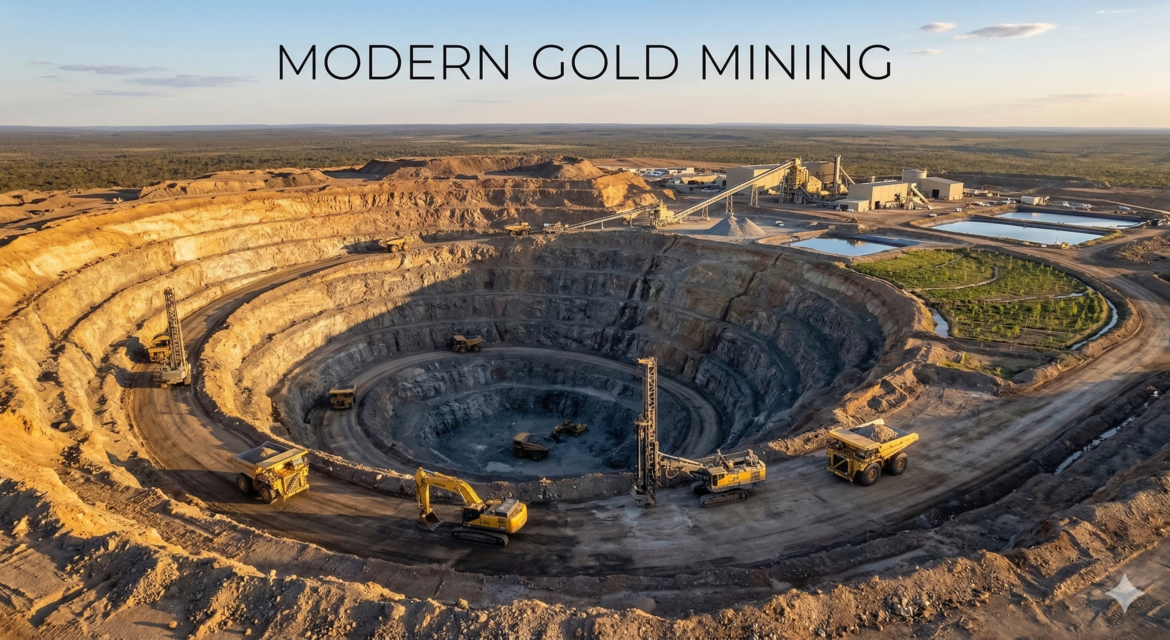
With permits secured and financing in place, construction and mining can begin. Depending on the depth and geometry of the orebody, we deploy either open-pit or underground mining methods — or a combination of both.
In open-pit operations, large earthmoving fleets remove waste rock to expose the ore, which is then blasted, loaded, and hauled to the processing plant. Underground operations involve developing a network of tunnels and drives to access mineralisation that sits too deep for open-cut extraction.
Across both methods, real-time grade control is critical. Eldoreydo Mining’s geologists sample and assay ore at the face on a continuous basis, ensuring that only economic material is sent for processing and that waste is kept separate.
Stage 4: Processing — Turning Ore into Gold
The processing plant is where geology meets chemistry. Ore is first crushed and ground to a fine particle size, liberating the gold from the surrounding rock. From there, various recovery methods are applied depending on the ore type:
- Gravity concentration — using density differences to separate gold particles
- Flotation — attaching gold-bearing minerals to air bubbles for collection
- Carbon-in-Leach (CIL) or Carbon-in-Pulp (CIP) — dissolving gold using cyanide solution and adsorbing it onto activated carbon
- Electrowinning and smelting — stripping the gold from carbon and refining it into doré bars
Eldoreydo Mining’s metallurgical engineers continuously optimise these circuits to maximise gold recovery, minimise reagent consumption, and reduce the environmental footprint of processing operations.
Stage 5: Rehabilitation — Returning the Land
Responsible mining doesn’t end when the gold runs out. Eldoreydo Mining runs progressive rehabilitation programmes concurrent with active mining — restoring mined areas with native vegetation, managing topsoil carefully, and monitoring water quality and soil health over the long term.
Our tailings storage facilities are engineered and managed to the Global Industry Standard on Tailings Management (GISTM), with independent reviews, real-time instrumentation, and emergency response planning in place at every site.
Conclusion
Modern gold mining is a science-driven, engineering-intensive, and increasingly environmentally conscious discipline. At Eldoreydo Mining, each of the five stages described above is executed with precision, rigour, and a commitment to leaving a net positive legacy — for our investors, for local communities, and for the environment.